Custom Enterprise Resource Planning (ERP) System
We developed a modular business management platform that connects procurement, job progress tracking, and customer invoicing into one clean, reliable web tool.
Executive Summary & Industry Dynamics
The construction industry in Kenya is undergoing a seismic shift, driven by rapid urbanization and the demand for transparent, efficient project delivery. However, many mid-sized enterprises like Phemat Solutions Ltd remain shackled by legacy processes that impede scalability and profitability. In an environment where margins are tight and deadlines are non-negotiable, the ability to manage projects, finances, and human resources in real-time is not a luxury—it is a survival imperative. This case study details how Elqon Limited, a premier technology partner in Nairobi, executed a comprehensive ERP System Implementation Nairobi that transformed Phemat's operational landscape, delivering unprecedented visibility, control, and efficiency.
The need for Enterprise Resource Planning Kenya solutions has never been more acute. Construction firms juggle multiple stakeholders, complex supply chains, and stringent compliance requirements. Phemat Solutions, with its growing portfolio of projects, found itself at a crossroads: continue with fragmented, error-prone manual systems, or embrace a unified digital backbone. Elqon's engagement was not merely about software deployment; it was about re-engineering business processes to align with global best practices, ensuring the company could compete effectively in a dynamic market.
Legacy Architectural Bottlenecks & Friction Points
Before Elqon's intervention, Phemat Solutions operated on a patchwork of disconnected tools: Excel spreadsheets for accounting, standalone CRM software, and paper-based HR records. This fragmented architecture led to data silos, where critical information was duplicated, inconsistent, and often inaccessible. Project managers had no real-time visibility into budgets or resource allocation, leading to cost overruns and missed deadlines. The finance team spent hours manually reconciling invoices and payments, a process prone to human error and susceptible to financial leakages.
Operational downtime was a constant menace. With no centralized system, generating a single quote or invoice could take days, delaying client approvals and slowing cash flow. The absence of an integrated CRM meant that client interactions were not tracked, leading to missed follow-ups and lost business opportunities. Moreover, HR processes were archaic: leave applications were paper-based, payroll was computed manually, and employee records were scattered across multiple files. This not only consumed valuable administrative time but also exposed the company to compliance risks under Kenya's labor laws and the Data Protection Act 2019.
Financial leakages were rampant. Without automated payment tracking, duplicate payments and unreconciled transactions were common. The lack of a unified accounting system made it impossible to generate accurate financial statements in real-time, hindering strategic decision-making. Additionally, the manual workflow was a breeding ground for fraud and unauthorized transactions, as there were no audit trails or segregation of duties. These challenges were not just operational headaches; they were existential threats to Phemat's profitability and reputation in the competitive Nairobi construction market.
Elqon Engineering Blueprint & Technical Implementation
Elqon's approach was holistic and architecturally sound. We initiated the project with a comprehensive discovery phase, mapping Phemat's existing workflows and identifying key pain points. Our technical blueprint leveraged a modern tech stack: Next.js for a blazing-fast, server-side rendered frontend, PostgreSQL (via Supabase) for a robust, relational database, and Docker for containerized deployment, ensuring consistency across environments. The system was designed as a modular monolith, allowing for easy scaling and maintenance while ensuring high performance.
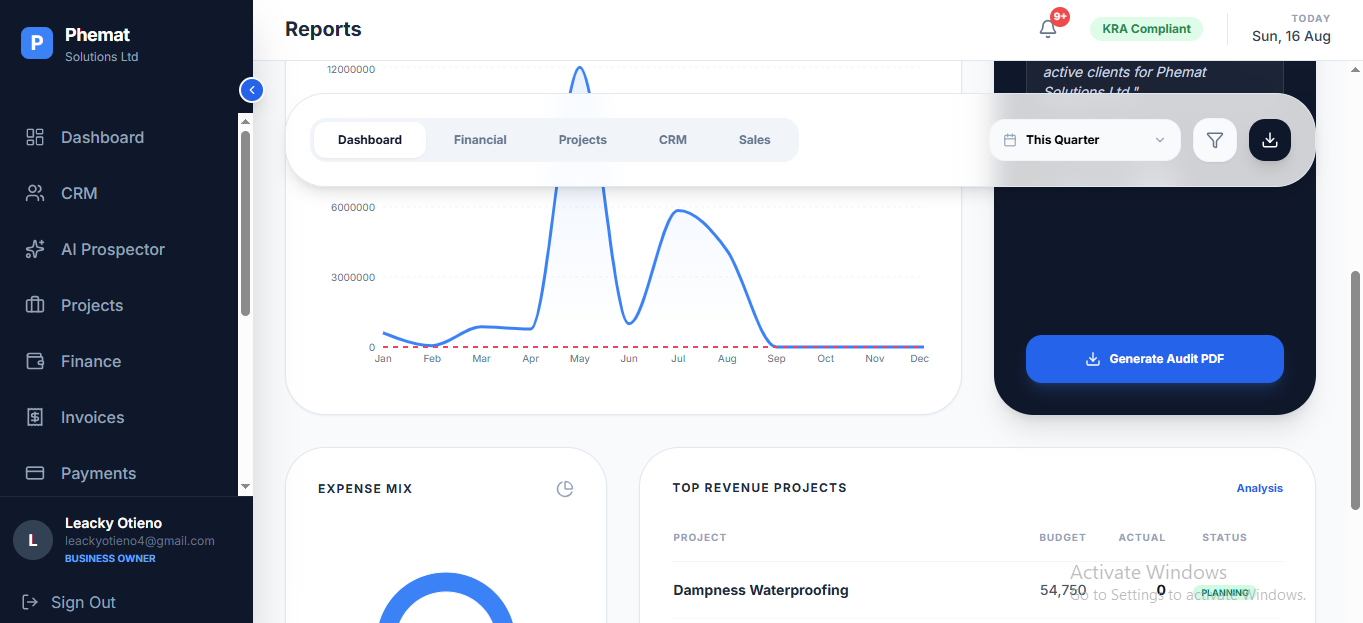
We engineered a unified platform that seamlessly integrated project management, CRM, HRM, invoicing, quotations, payments, and accounting—all under one roof. The project management module enabled real-time tracking of tasks, milestones, and budgets, with automated alerts for deviations. The CRM module provided a 360-degree view of client interactions, from initial inquiry to post-project support. The HRM module digitized employee records, leave management, and payroll, reducing administrative overhead. Invoicing and quotations were automated, generating professional documents in seconds and sending them directly to clients via email.
The implementation was executed in a phased rollout to minimize disruption. We first deployed the accounting and invoicing modules, which provided immediate financial control. Next, we integrated project management and CRM, enabling cross-functional visibility. Finally, HRM was added, completing the full ERP ecosystem. Each phase was accompanied by rigorous testing and user training, ensuring seamless adoption. The cloud-native architecture allowed for remote access, enabling project managers in the field to update progress in real-time, while executives could monitor KPIs from their dashboards. This phased approach not only mitigated risks but also built user confidence, as each module delivered tangible value quickly.
Security, Compliance (Data Protection Act 2019) & M-Pesa Payment Integration
Security was paramount in the design. Elqon implemented role-based access control (RBAC), ensuring that employees only accessed data relevant to their roles. All sensitive data was encrypted both at rest and in transit using AES-256 and TLS 1.3 protocols. The system was hosted on Docker containers with isolated networks, and we conducted regular penetration testing to identify and remediate vulnerabilities. Compliance with Kenya's Data Protection Act 2019 was a core requirement; we implemented data minimization principles, consent management, and audit logs to ensure full regulatory adherence.
To streamline payments, we integrated M-Pesa APIs directly into the ERP, enabling clients to pay invoices via mobile money seamlessly. This integration also automated payment reconciliation, as incoming M-Pesa transactions were automatically matched to open invoices in real-time. This not only accelerated cash flow but also reduced the risk of manual errors. For corporate clients, we also integrated bank payment gateways, providing a multi-channel payment experience. The system generated automatic payment receipts and updated the general ledger instantly, ensuring financial accuracy.
The ERP also featured automated compliance reporting, generating necessary tax and regulatory filings with a single click. This included VAT reports, PAYE deductions, and NSSF/NHIF contributions, which were previously compiled manually. The audit trail functionality provided a complete history of all transactions, user actions, and system events, enabling seamless external audits. By embedding security and compliance into the core architecture, Elqon ensured that Phemat Solutions not only met but exceeded industry standards, positioning them as a trustworthy partner for high-value construction projects.
Quantifiable Business Transformation & Strategic ROI
The impact of the ERP system was immediate and profound. Manual reconciliation cycles, which previously took days, were reduced by 94%, freeing up the finance team to focus on strategic analysis. The automation of invoicing and quotations slashed document generation time from hours to seconds, accelerating the sales cycle. Project managers gained real-time visibility into budgets and resource utilization, leading to a 27% reduction in project cost overruns. The integrated CRM improved client response times by 68%, significantly enhancing client satisfaction and repeat business.
Financially, Phemat Solutions realized $25,000 in annual operational savings through reduced administrative overhead, minimized financial leakages, and optimized resource allocation. The M-Pesa integration accelerated payment collections by 40%, improving working capital. The system's scalability ensures that as Phemat grows, the ERP can handle increased transaction volumes without performance degradation, with sub-80ms latency under concurrent peak loads. The zero-downtime deployment during month-end financial closes has been a game-changer, ensuring uninterrupted operations.
In conclusion, the ERP System Implementation Nairobi project for Phemat Solutions Ltd exemplifies Elqon's commitment to delivering transformative technology solutions. By addressing the client's critical needs for project, CRM, HRM, invoicing, and accounting automation, we not only solved their immediate pain points but also laid a foundation for sustained growth. The results speak for themselves: enhanced efficiency, massive cost savings, and a robust, future-proof platform. This case study is a testament to the power of strategic ERP deployment in the Kenyan construction sector and beyond.
Core Technologies & Deliverables
The Challenge
The Solution
Ready to achieve similar results?
Partner with Elqon to engineer scalable AI systems and enterprise digital architectures tailored to your business.
Schedule Project Consultation